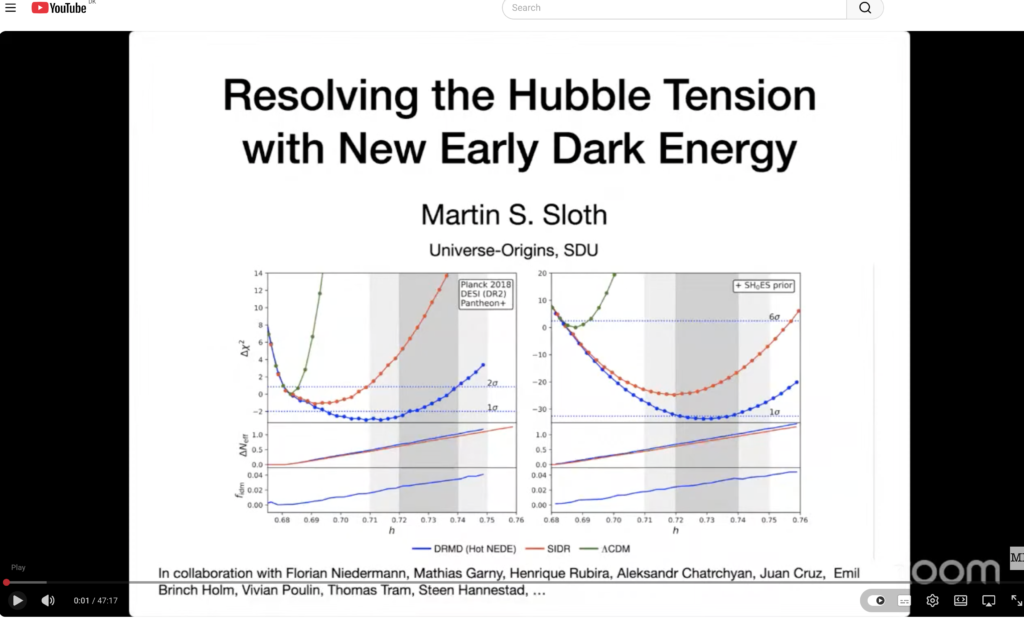
A new early-universe explanation of the DESI anomaly connecting to the predictions of our solution to the Hubble tension in collaboration with Mathias Garny and Florian Niedermann: https://arxiv.org/abs/2512.15870

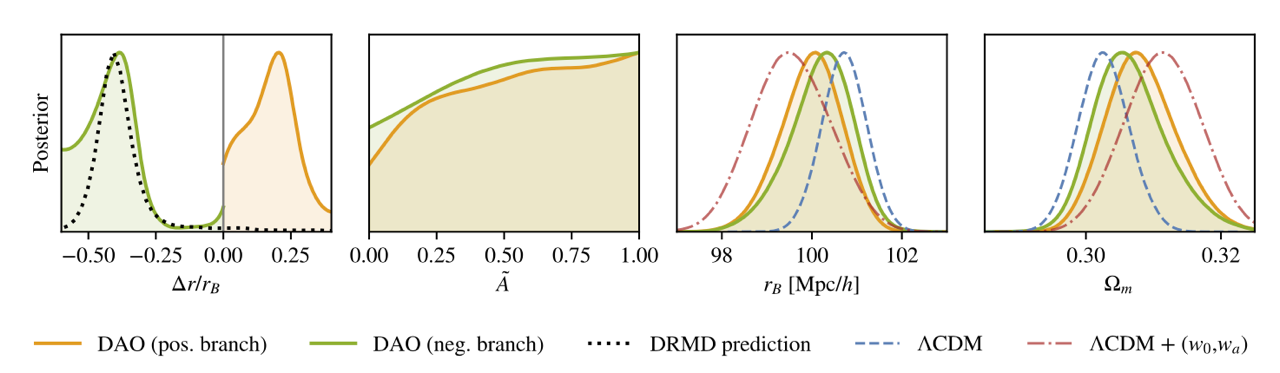
The presence of a Dark Acoustic Oscillation (DAO) near the actual BAO may appear as a single BAO-only feature with a slightly shifted peak position, which could bias the DESI BAO measurements, thereby explaining the anomaly in the DESI DR2 data without invoking late-time-evolving Dark Energy. The DAO predicted in our model for solving the Hubble tension, Hot New Early Dark Energy (Hot NEDE) with Dark Radiation Matter Decoupling (DRMD), also meets the requirements for explaining the DESI results, as shown in the leftmost panel of the figure below. The green curve is the favoured DAO position by the DESI DR2 data on small scales, and the dotted black line is the prediction of DRMD in Hot NEDE, when solving the Hubble tension.

Screenshot 2025-12-19 at 07.52.54.png

In a new paper “we explore the possibility that exotic forms of dark matter could expose humans on Earth or on prolonged space travel to a significant radiation dose. The radiation exposure from dark matter interacting with nuclei in the human body is generally assumed to be negligible compared to other sources of background radiation. However, as we discuss here, current data allow for dark matter models where this is not necessarily true”. See: https://arxiv.org/abs/2411.10521

The ESA Euclid experiment will map around a billion galaxies in the next six years and give us new insights into the properties of Dark Matter and Dark Energy. Today, Euclid released its first pictures: Euclid’s first images.

Euclids view of the Perseus cluster of galaxies

First Sloth in space! Zero-G indicator on today’s mission to the space station was a Sloth 🦥