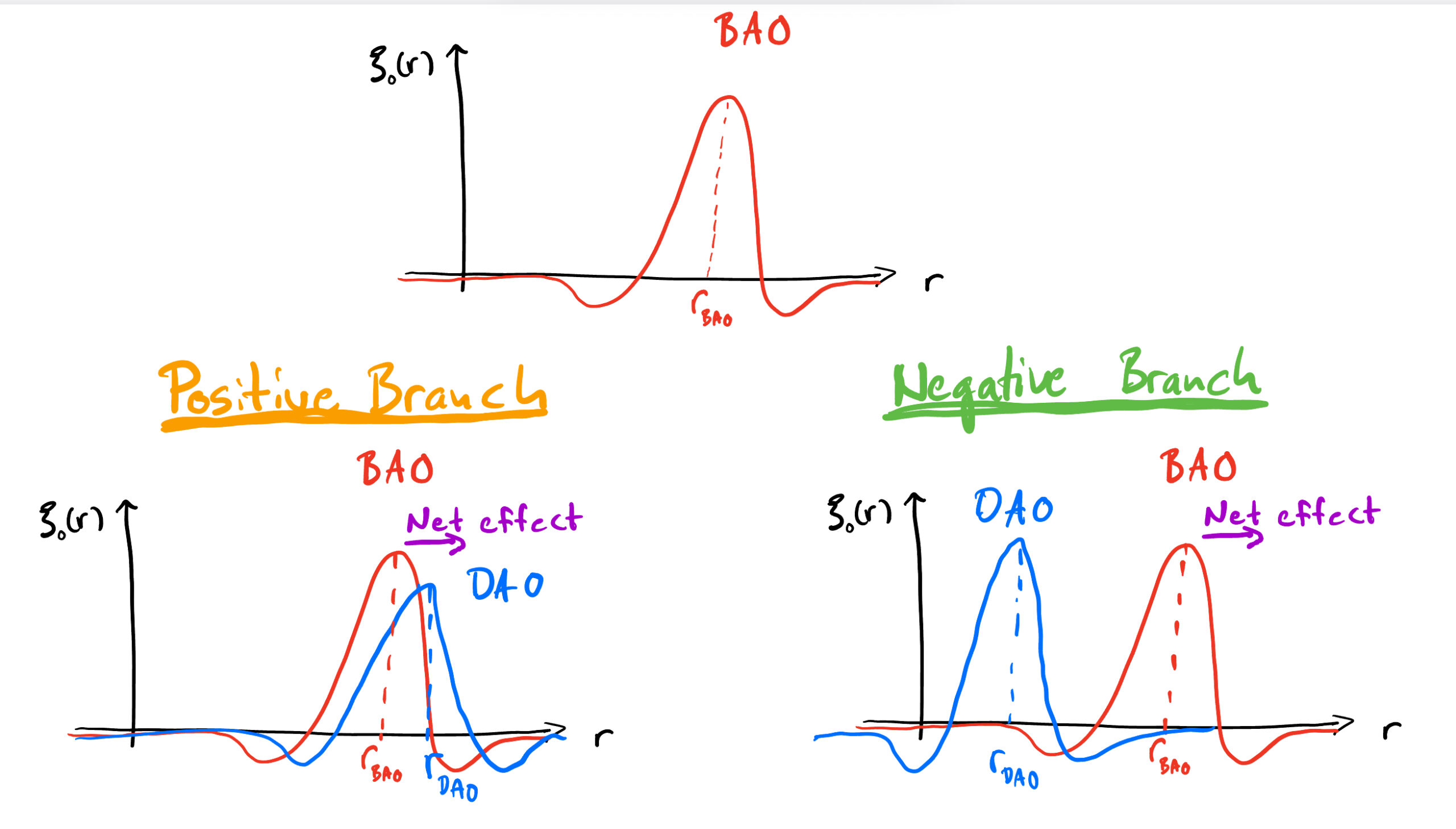
Below is a cartoon illustration of the negative branch versus the positive branch discussed in the video linked in the previous post and in our paper: https://arxiv.org/abs/2512.15870

As we discuss in the paper:

On the positive branch, the DAO is almost on top of the BAO but at a slightly larger scale, and it will shift the perceived peak of the BAO slightly to the positive side of the DAO.

On the negative branch, the BAO and the DAO peaks are well separated, but close; the characteristic tail of the DAO can shift the perceived position of the BAO in the opposite
direction away from the DAO. In this case, the main peak of the DAO is assumed to be at a sufficiently small scale where it could be hidden by non-linear systematics in currently publicly available DESI DR2 data.

Both the positive and negative branches could potentially be discoverable in future DESI data releases or upcoming surveys like Euclid, by either resolving the DAO peak that overlaps closely with the BAO, or identifying a shallow DAO peak on scales∼50Mpc/h somewhat smaller than the BAO, consistent with our predictions in our earlier work as a result of solving the Hubble tension: https://arxiv.org/abs/2508.03795

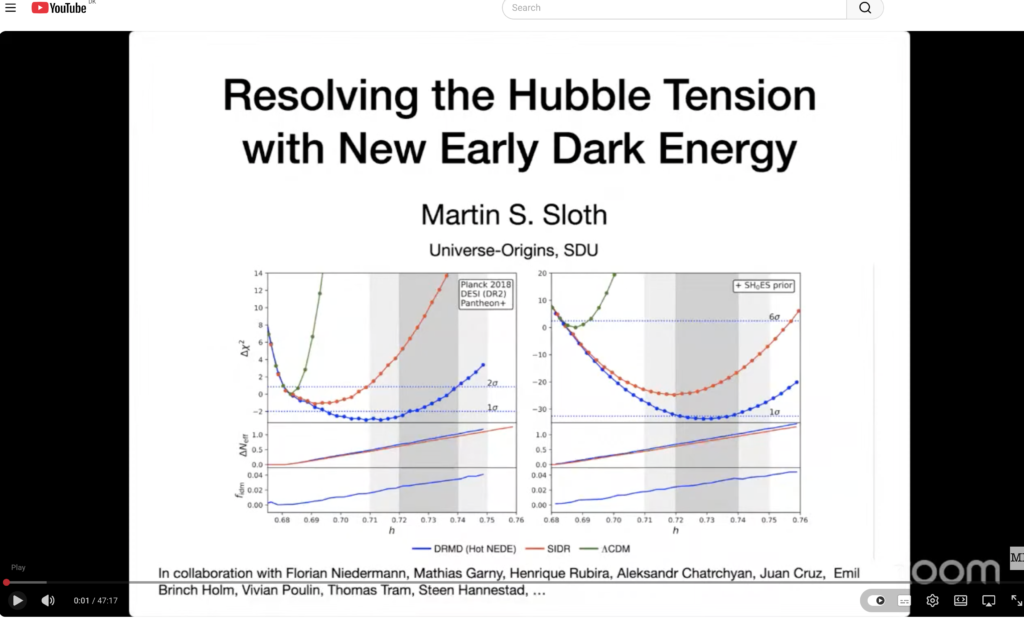
At a recent DESY (Hamburg) colloquium, I gave a review talk on “Resolving the Hubble Tension with New Early Dark Energy.”

I explained how the DESI anomaly might be connected to the Hubble tension and have an early-universe explanation in terms of dark acoustic oscillations. 

Link to: Slides + full video

The paper mentioned in the video clip below (now online): arXiv:2512.15870 — https://arxiv.org/abs/2512.15870

This builds on earlier work on New Early Dark Energy, with excellent collaborators: Florian Niedermann, Mathias Garny, Henrique Rubira, Aleksandr Chatrchyan, Juan Cruz, Emil Brinch Holm, Vivian Poulin, Thomas Tram, Steen Hannestad …

A new early-universe explanation of the DESI anomaly connecting to the predictions of our solution to the Hubble tension in collaboration with Mathias Garny and Florian Niedermann: https://arxiv.org/abs/2512.15870

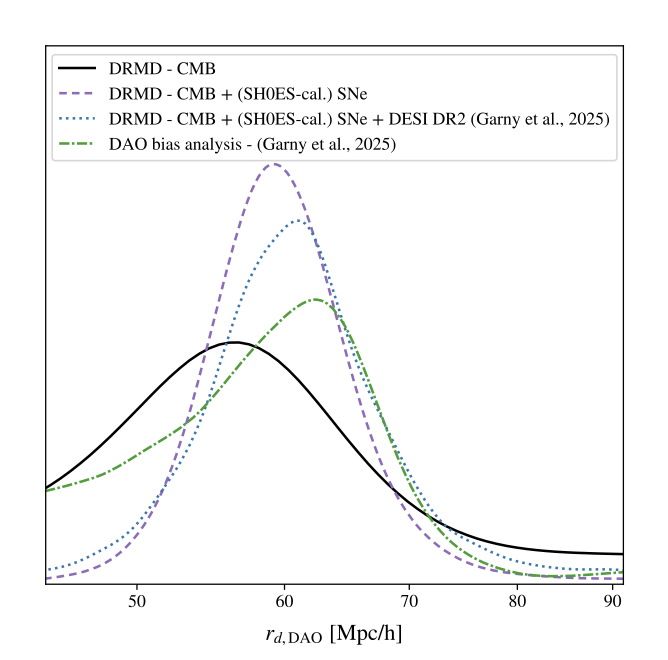
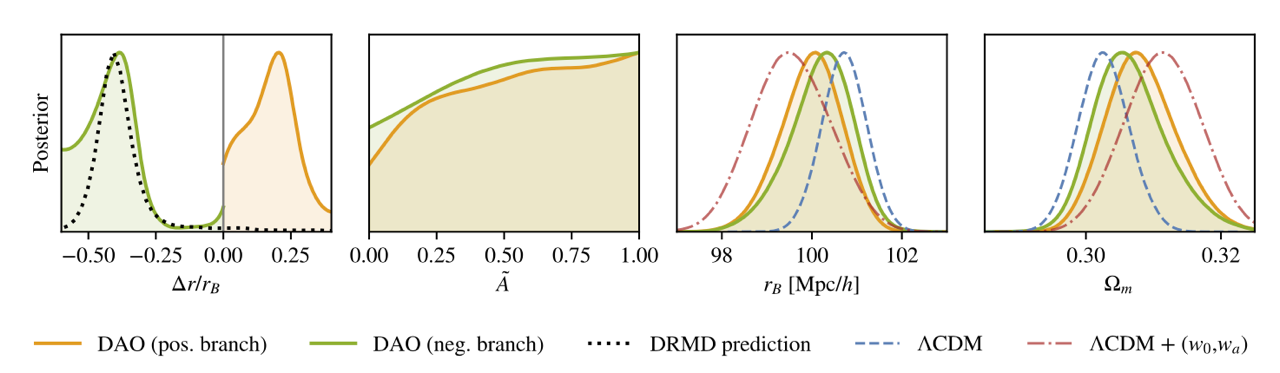
The presence of a Dark Acoustic Oscillation (DAO) near the actual BAO may appear as a single BAO-only feature with a slightly shifted peak position, which could bias the DESI BAO measurements, thereby explaining the anomaly in the DESI DR2 data without invoking late-time-evolving Dark Energy. The DAO predicted in our model for solving the Hubble tension, Hot New Early Dark Energy (Hot NEDE) with Dark Radiation Matter Decoupling (DRMD), also meets the requirements for explaining the DESI results, as shown in the leftmost panel of the figure below. The green curve is the favoured DAO position by the DESI DR2 data on small scales, and the dotted black line is the prediction of DRMD in Hot NEDE, when solving the Hubble tension.

Screenshot 2025-12-19 at 07.52.54.png

New community report today uses different methods and techniques to establish the value of the Hubble constant to 1% precision, H0=73.50+/-0.81 km/s/Mpc, confirming the Hubble tension at more than 5-sigma.

This means that our current standard model of the Universe, the ΛCDM model, can not describe the real Universe as we observe it, and we must move to finding the correct model of our Universe replacing ΛCDM.

New Early Dark Energy (NEDE) has proven itself to be a promising framework in which to search for the solution to the Hubble tension (see previous posts), and we will keep intensifying our efforts to explore NEDE.

See the community report here: https://arxiv.org/abs/2510.23823

To make sense of the Hubble tension, it is essential to have a simple (in terms of ideas), convincing solution. In a new paper, we present a new microscopic Hot NEDE model of the dark sector based on well-known fundamental principles, gauge symmetry, and spontaneous symmetry breaking, which resolves the Hubble tension. We also discuss how this solution can be further tested with future precision data.

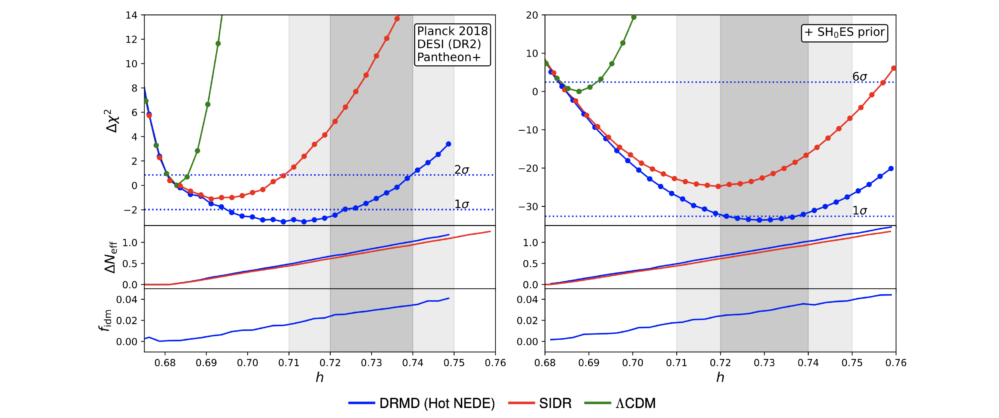
Profile likelihood curves for the model from our paper can be seen below.  

Work in collaboration with Mathias Garny, Florian Niedermann and Henrique Rubira.

The paper is on arXiv: https://arxiv.org/abs/2508.03795.

“Simplicity is part of what I mean by beauty, but it is a simplicity of ideas, not simplicity of a mechanical sort that can be measured by counting equations or symbols.”

— Steven Weinberg

In an update of our recent paper with Aleksandr Chatrchyan, Florian Niedermann, and Vivian Poulin, we have included fits of Cold New Early Dark Energy (Cold NEDE) to the DESI BAO data. 

Using  CMB Planck Plik data, DESI BAO, and Pantheon+ data, we find around 2-sigma evidence for NEDE (see upper left panel below), which is enhanced to 6-sigma evidence when including SH0ES supernovae data (see upper right panel below). 

Without including SH0ES data, a value of H0=73 km/s/Mpc, compatible with SH0ES findings, is allowed within 2-sigma using Planck Plik, DESI BAO, and Pantheon+ data (see lower left panel below). Including SH0ES data, the Lambda-CDM preferred value of H0 less than 68 km/s/Mpc is excluded at 6-sigma in the Cold NEDE model.

For likelihoods with other dataset combinations, parameters, and discussion, see our full paper: https://arxiv.org/abs/2408.14537.

In a new paper with Aleksandr Chatrchyan, Florian Niedermann, and Vivian Poulin (https://arxiv.org/abs/2408.14537), we generalize the treatment of the NEDE fluid in the Cold NEDE model and test it against updated CMB and Supernovae data. We show that in the Cold NEDE model, the NEDE fluid can, as previously anticipated, be described as a mix of stiff fluid and radiation consistently with data. 

The new CMB Planck NPIPE data and Pantheon+ supernova data slightly increase the tension between ΛCDM and SH0ES. This similarly slightly increases the residual tension in (N)EDE models when relieving the Hubble tension, with Cold NEDE doing slightly better than AxiEDE and other EDE-type models. On the other hand, we know from other studies that the recent DESI data pulls in the opposite direction toward reducing the residual tension by a similar amount. In conclusion, further improvements in data and NEDE model building provide a constructive and promising way forward. 

Finally, we have made a non-trivial test of the Cold NEDE model. In the Cold NEDE model, it is a theoretical prediction that the ratio between the Hubble rate at the time of the phase transition, H*, and the mass of the trigger field, m, should satisfy H*/m ~ 0.2. Being agnostic about the underlying model and fitting H* and m as free parameters to the data is a way of testing this specific prediction of Cold NEDE. It is spectacular that we find a peak in the probability distribution for H*/m between 0.20 and 0.22 as predicted (see figure below).

Screenshot 2024-08-28 at 09.01.28.png

Two new analyses of the Hubble tension are based solely on data from the JWST telescope and serve as a check of the measurements using the Hubble Space Telescope (HST), which initially led to the tension in the first place. In the paper today (https://arxiv.org/abs/2408.11770), a value of H0 of 72.6 plus-minus 2.0 km/s/Mpc using JWST data alone is reported. This is also consistent with previous values reported by SH0ES using HST data and consistent with the slightly lower values reported by the CCHP team in another analysis based on JWST data alone (https://arxiv.org/abs/2408.06153) when accounting for the smaller subsample of supernovae used by CCHP. Restricting their analysis to the same smaller subsample as used by CCHP, the SH0ES team reproduces their values, a strong indication of overall agreement. It seems we are very close to a confirmation of the Hubble tension independent from the original HST data.

Figure from Riess et. al. 2024 [2408.11770]