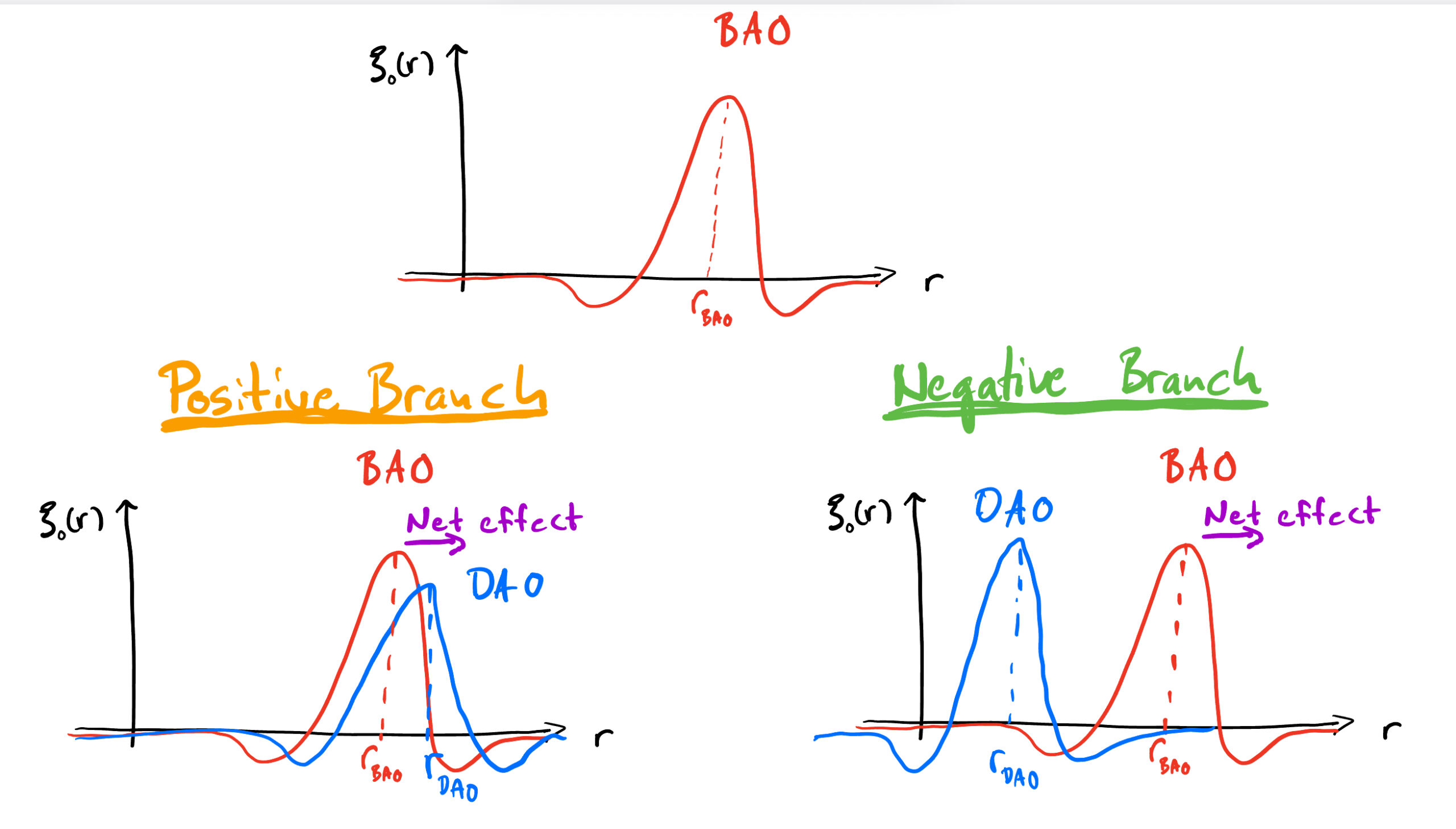
Below is a cartoon illustration of the negative branch versus the positive branch discussed in the video linked in the previous post and in our paper: https://arxiv.org/abs/2512.15870
As we discuss in the paper:
On the positive branch, the DAO is almost on top of the BAO but at a slightly larger scale, and it will shift the perceived peak of the BAO slightly to the positive side of the DAO.
On the negative branch, the BAO and the DAO peaks are well separated, but close; the characteristic tail of the DAO can shift the perceived position of the BAO in the opposite
direction away from the DAO. In this case, the main peak of the DAO is assumed to be at a sufficiently small scale where it could be hidden by non-linear systematics in currently publicly available DESI DR2 data.
Both the positive and negative branches could potentially be discoverable in future DESI data releases or upcoming surveys like Euclid, by either resolving the DAO peak that overlaps closely with the BAO, or identifying a shallow DAO peak on scales∼50Mpc/h somewhat smaller than the BAO, consistent with our predictions in our earlier work as a result of solving the Hubble tension: https://arxiv.org/abs/2508.03795