The Hubble tension and the DESI anomaly are considered to both seriously challenge the standard model of cosmology (the ΛCDM model).

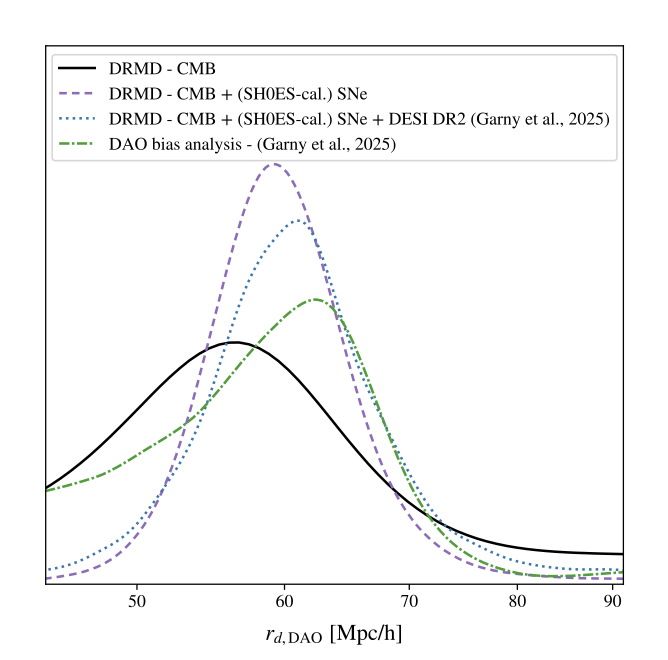
In a new paper, we predict Dark Acoustic Oscillations (DAO) as the fingerprint of new dark forces required to resolve the Hubble tension in the Dark Radiation-Matter Decoupling (DRMD) model, naturally realised within the Hot New Early Dark Energy (Hot NEDE) setup. DAOs, with the same properties required to solve the Hubble tension, can independently explain the DESI anomaly.

Using an inference independent of large-scale structure data, relying only on Planck measurements of the cosmic microwave background and SH0ES-calibrated supernova data, we find evidence for a DAO signal with drag-horizon scale rd,DAO ∈[54,65] Mpc/h (68% C.I.) and amplitude ADAO ∈[0.02,0.05] (68% C.I.). These predictions provide a concrete target for current and upcoming large-scale structure surveys, including DESI, Euclid, and the Roman Space Telescope.

It is remarkable that the scale and amplitude of the DAO required for solving the Hubble tension using only CMB and supernova data (no DESI BAO data), overlaps with the DAO scale and an amplitude independently preferred by the DESI BAO data (see my two previous posts), when the DESI anomaly is interpreted as being due to a DAO bias (as an alternative to the evolving dark energy interpretation) — providing a preliminary independent verification of DRMD’s relevance for solving the Hubble tension.

The work in collaboration with Mathis Garny and Florian Niedermann is on arXiv: https://arxiv.org/abs/2602.23895

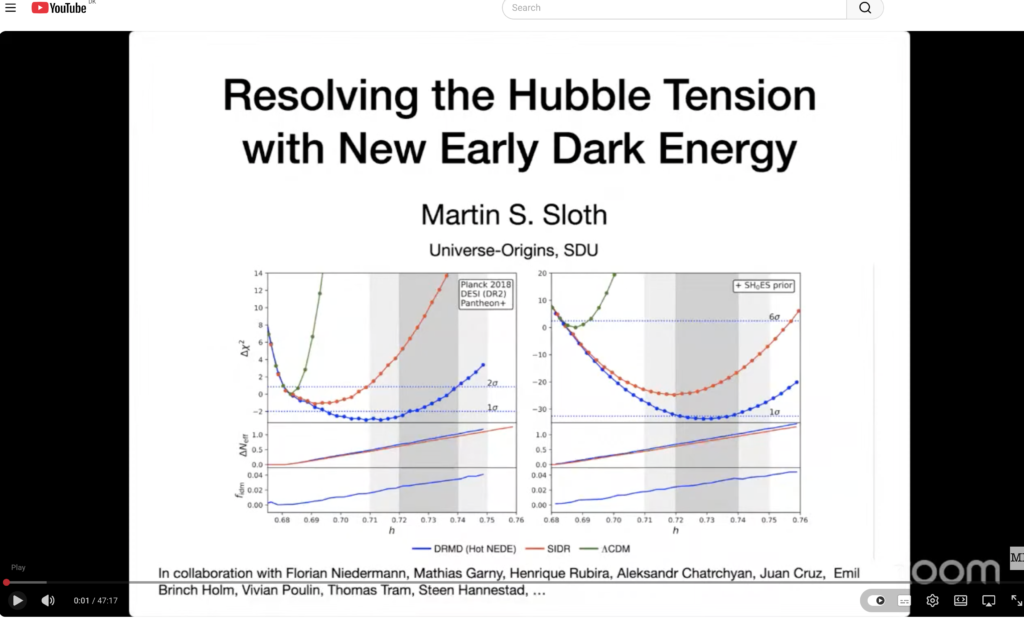
At a recent DESY (Hamburg) colloquium, I gave a review talk on “Resolving the Hubble Tension with New Early Dark Energy.”

I explained how the DESI anomaly might be connected to the Hubble tension and have an early-universe explanation in terms of dark acoustic oscillations. 

Link to: Slides + full video

The paper mentioned in the video clip below (now online): arXiv:2512.15870 — https://arxiv.org/abs/2512.15870

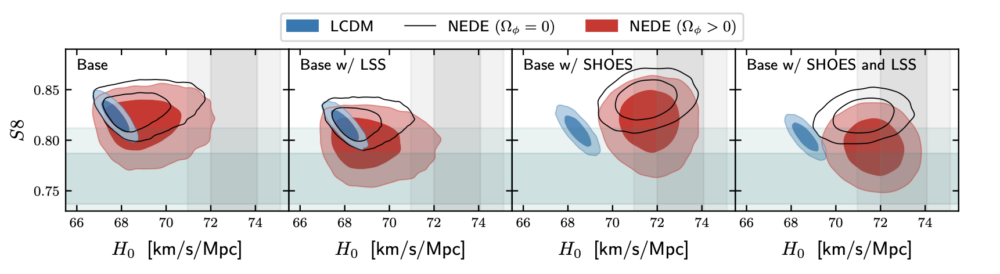
This builds on earlier work on New Early Dark Energy, with excellent collaborators: Florian Niedermann, Mathias Garny, Henrique Rubira, Aleksandr Chatrchyan, Juan Cruz, Emil Brinch Holm, Vivian Poulin, Thomas Tram, Steen Hannestad …

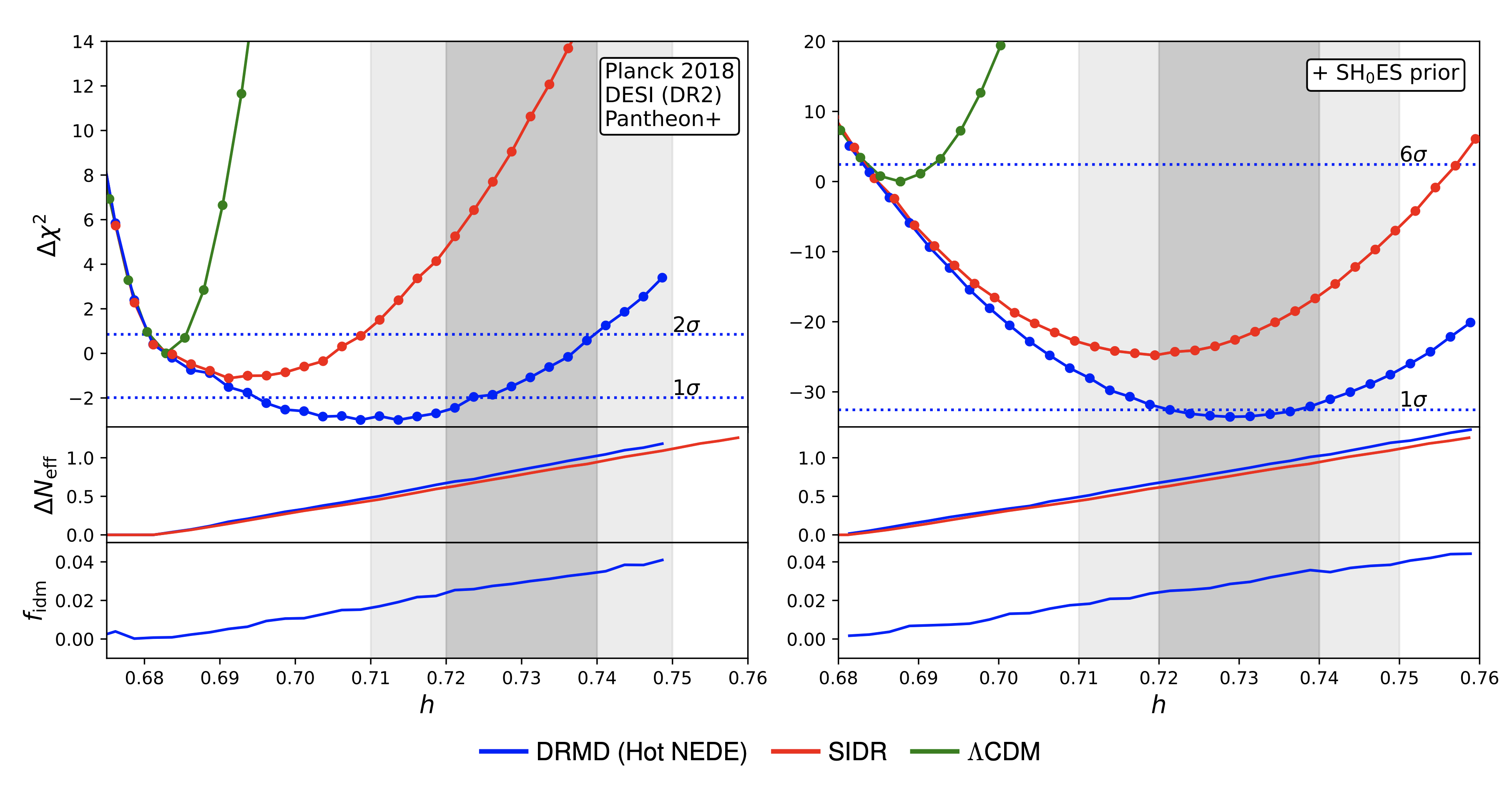
To make sense of the Hubble tension, it is essential to have a simple (in terms of ideas), convincing solution. In a new paper, we present a new microscopic Hot NEDE model of the dark sector based on well-known fundamental principles, gauge symmetry, and spontaneous symmetry breaking, which resolves the Hubble tension. We also discuss how this solution can be further tested with future precision data.

Profile likelihood curves for the model from our paper can be seen below.  

Work in collaboration with Mathias Garny, Florian Niedermann and Henrique Rubira.

The paper is on arXiv: https://arxiv.org/abs/2508.03795.