New community report today uses different methods and techniques to establish the value of the Hubble constant to 1% precision, H0=73.50+/-0.81 km/s/Mpc, confirming the Hubble tension at more than 5-sigma.

This means that our current standard model of the Universe, the ΛCDM model, can not describe the real Universe as we observe it, and we must move to finding the correct model of our Universe replacing ΛCDM.

New Early Dark Energy (NEDE) has proven itself to be a promising framework in which to search for the solution to the Hubble tension (see previous posts), and we will keep intensifying our efforts to explore NEDE.

See the community report here: https://arxiv.org/abs/2510.23823

To make sense of the Hubble tension, it is essential to have a simple (in terms of ideas), convincing solution. In a new paper, we present a new microscopic Hot NEDE model of the dark sector based on well-known fundamental principles, gauge symmetry, and spontaneous symmetry breaking, which resolves the Hubble tension. We also discuss how this solution can be further tested with future precision data.

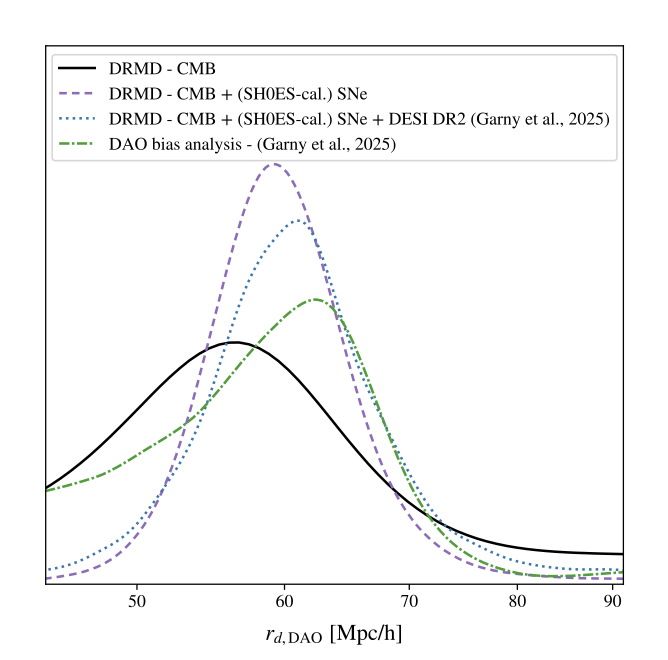
Profile likelihood curves for the model from our paper can be seen below.  

Work in collaboration with Mathias Garny, Florian Niedermann and Henrique Rubira.

The paper is on arXiv: https://arxiv.org/abs/2508.03795.

“Simplicity is part of what I mean by beauty, but it is a simplicity of ideas, not simplicity of a mechanical sort that can be measured by counting equations or symbols.”

— Steven Weinberg

In a new paper, “I demonstrate that soft graviton modes in de Sitter are the Goldstone modes of the spontaneously broken asymptotic symmetry group of de Sitter. I then show that any local measurement, including the effects of the environment, will collapse the symmetric state onto the broken state in the large volume limit. In any discussion involving observers, de Sitter is, therefore, best described globally by the broken phase, while local observers, in the small volume limit, can not discriminate between different degenerate global vacuum states, and are therefore best described by the symmetric state. This illuminates the physical nature of soft graviton modes in de Sitter.”

As a bonus, I also speculate about the possibility that a new type of crystals, with the same symmetry-breaking pattern as discussed in the paper, could be realized in the laboratory as an analog system of de Sitter and eternal inflation.

The paper is on arXiv:  https://arxiv.org/abs/2502.03520