We might have observed “the end of the first act” of the universe’s evolution in recent high-precision CMB observations. In a new paper, we show that ACT DR6 data provide evidence for an accelerated running of the primordial spectral index, which would imply a breakdown of the first stage of inflation and, at the same time, resolve the Hubble tension in the DRMD Hot NEDE model (see previous posts). 

Inflation occurs during the first period of the universe’s evolution after the Big Bang, and observing the breakdown in the first stage of inflation therefore amounts to observing the end of the first act of the universe’s evolution. The accelerated running compensates for the increased damping at small scales in the CMB and therefore allows for a larger N_eff in models with self-interacting dark radiation, such as Hot NEDE with DRMD. The idea that inflation occurred in several acts (or stages) has long been considered more natural than 60 e-folds of single-field slow-roll inflation. In our paper, we also discuss how the end of the first act could occur through gauge-field production in axion monodromy-like inflation or through a tachyonic instability. For more details, see our new paper: https://arxiv.org/abs/2604.26541

Work in collaboration with Mathias Garny (Technical University of Munich) and Florian Niedermann (Nordita).

The Hubble tension and the DESI anomaly are considered to both seriously challenge the standard model of cosmology (the ΛCDM model).

In a new paper, we predict Dark Acoustic Oscillations (DAO) as the fingerprint of new dark forces required to resolve the Hubble tension in the Dark Radiation-Matter Decoupling (DRMD) model, naturally realised within the Hot New Early Dark Energy (Hot NEDE) setup. DAOs, with the same properties required to solve the Hubble tension, can independently explain the DESI anomaly.

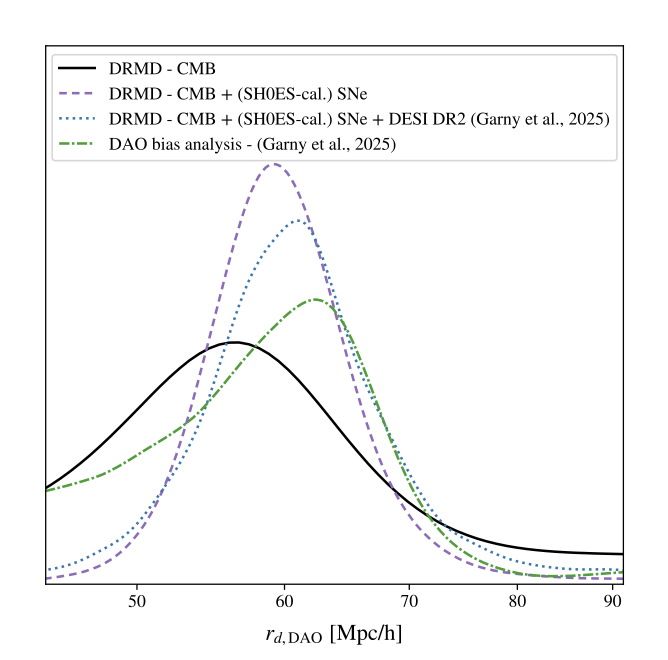
Using an inference independent of large-scale structure data, relying only on Planck measurements of the cosmic microwave background and SH0ES-calibrated supernova data, we find evidence for a DAO signal with drag-horizon scale rd,DAO ∈[54,65] Mpc/h (68% C.I.) and amplitude ADAO ∈[0.02,0.05] (68% C.I.). These predictions provide a concrete target for current and upcoming large-scale structure surveys, including DESI, Euclid, and the Roman Space Telescope.

It is remarkable that the scale and amplitude of the DAO required for solving the Hubble tension using only CMB and supernova data (no DESI BAO data), overlaps with the DAO scale and an amplitude independently preferred by the DESI BAO data (see my two previous posts), when the DESI anomaly is interpreted as being due to a DAO bias (as an alternative to the evolving dark energy interpretation) — providing a preliminary independent verification of DRMD’s relevance for solving the Hubble tension.

The work in collaboration with Mathis Garny and Florian Niedermann is on arXiv: https://arxiv.org/abs/2602.23895