Check out the excellent talk by my collaborator, Florian Niedermann, on New Early Dark Energy (NEDE) in the CosmoVerse seminar series linked below.
Category Archives: NEDE
Two interesting new papers:
One indicates that new physics in the dark sector at the two scales, the eV scale and a ULA scale, close to those inherent in the Cold NEDE solution to the Hubble tension, could be required by eBOSS Lyman-alpha data https://arxiv.org/abs/2311.16377.
And one that constrains a corner of NEDE parameter space in more detail from the microphysics of the phase transition https://arxiv.org/abs/2311.16222, emphasizing the requirement of a fast phase transition.
Not all approaches to the Hubble tension are equally good or bad. Some recent discussion seems to ignore the fact that early-time approaches like New Early Dark Energy also fit the CMB better than Lambda-CDM independent of the Hubble tension ( https://arxiv.org/abs/2305.08895 ).
Groningen group with a new paper *not* finding evidence of unknown systematics being the source of the Hubble tension. This further strengthens the case for early times (pre-recombination) new physics, like New Early Dark Energy (NEDE): https://arxiv.org/abs/2308.05157
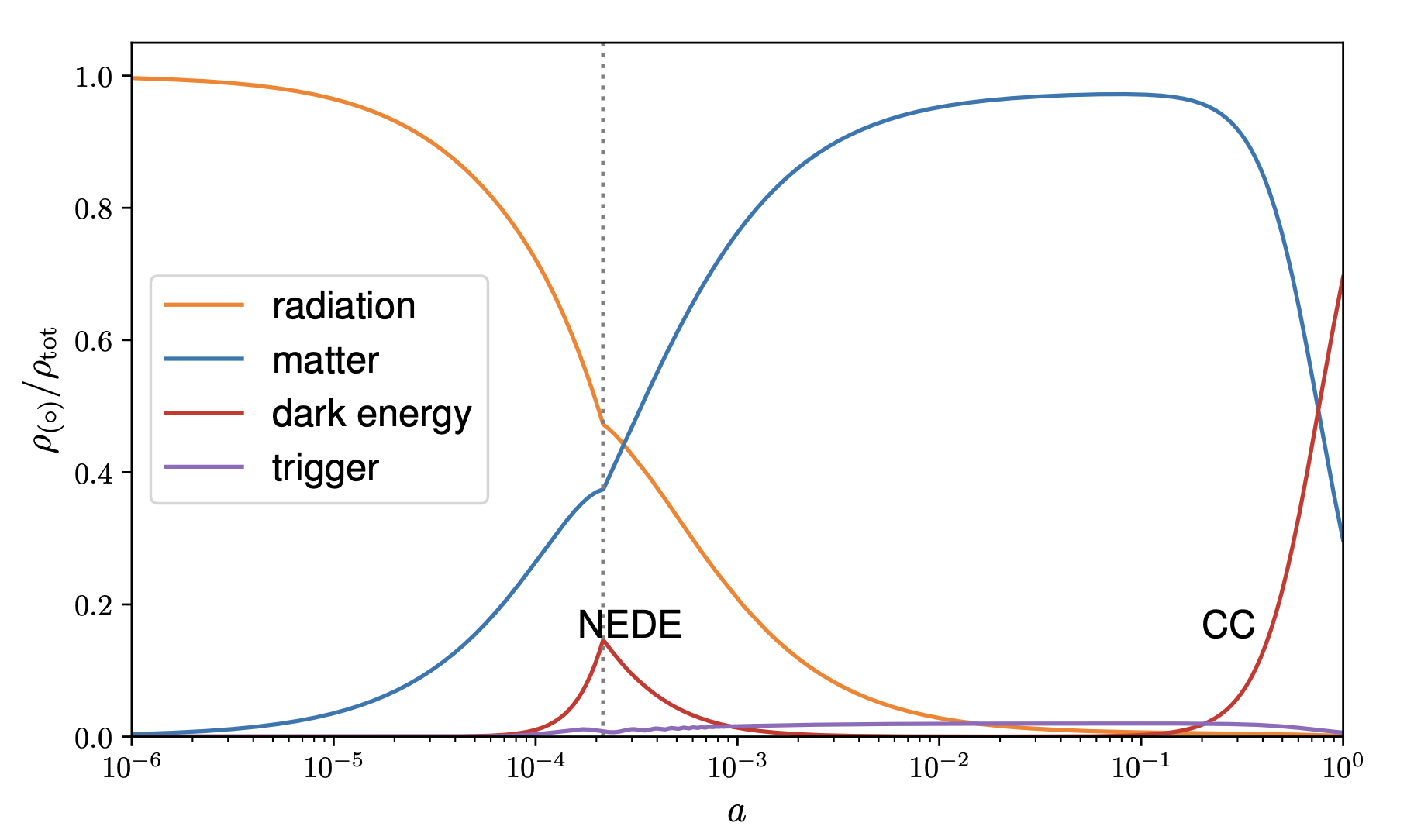
New review article with Florian Niedermann: “New Early Dark Energy as a Solution to the H0 and the S8 Tensions:” https://arxiv.org/abs/2307.03481. Contributed chapter to the book “Hubble Constant Tension.”
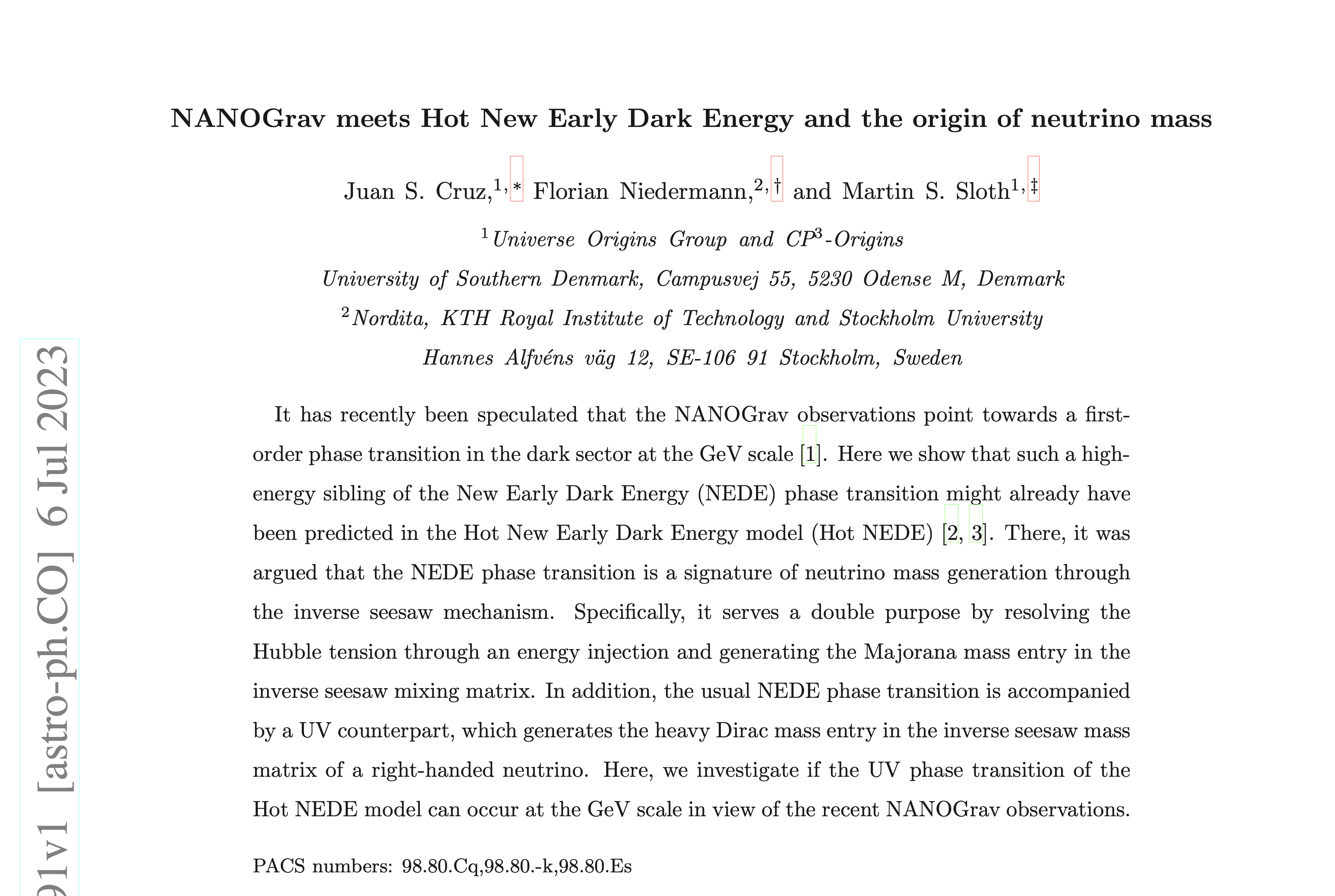
“NANOGrav meets Hot New Early Dark Energy and the origin of neutrino mass”: We show that in the Hot NEDE model, both the Hubble tension and the NANOGrav observations could be a signature of the origin of neutrino mass: https://arxiv.org/abs/2307.03091
Euclid will help us to determine the source of the Hubble tension. Its measurements of Large Scale Structure formation will help us to test and constrain models and provide valuable insight into New Early Dark Energy (NEDE) as a possible solution to the H0 and S8 tensions.
Cold NEDE solves both the S8 and the H0 tension without adding any new d.o.f. at the fundamental level: https://arxiv.org/abs/2305.08895 New work with Juan S. Cruz and Florian Niedermann

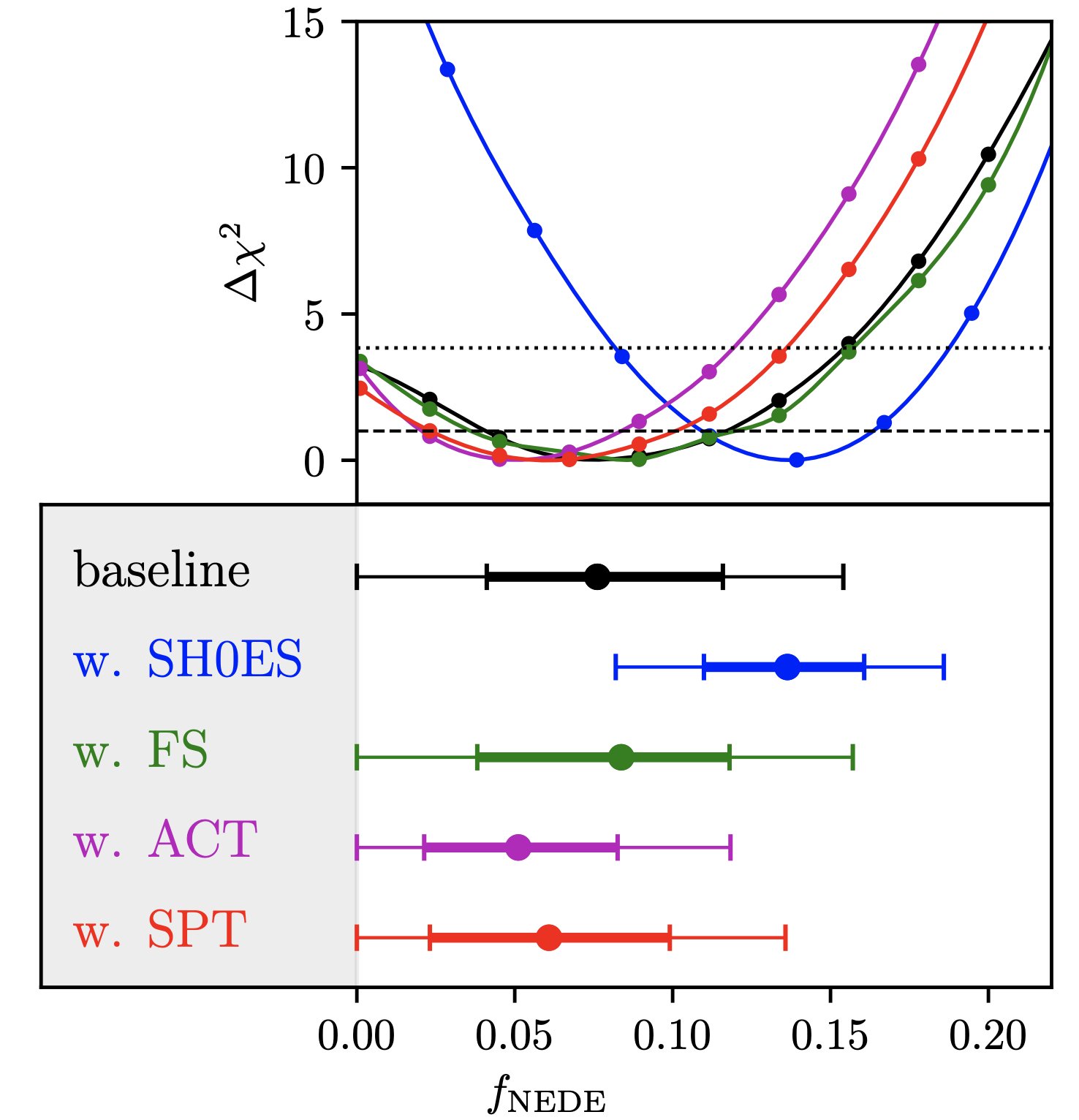
A new paper analyzing New Early Dark Energy (NEDE) using profile likelihood methods in collaboration with Aarhus U. group: Emil Brinch Holm, Thomas Tram, and Steen Hannestad and with Florian Niedermann at Nordita and Juan Cruz at SDU: https://arxiv.org/abs/2302.07934
In science, you have to be able to reach the same result by using different methods, and with the Hubble tension, physicists have a problem … here is a popular article about our method to solve this problem:
https://www.sdu.dk/en/nyheder/forskningsnyheder/boblende-univers