Cold NEDE solves both the S8 and the H0 tension without adding any new d.o.f. at the fundamental level: https://arxiv.org/abs/2305.08895 New work with Juan S. Cruz and Florian Niedermann

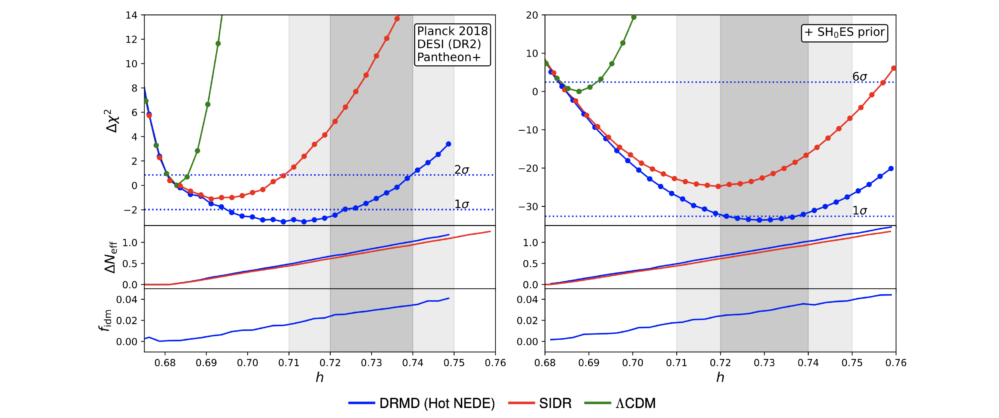
Cold NEDE solves both the S8 and the H0 tension without adding any new d.o.f. at the fundamental level: https://arxiv.org/abs/2305.08895 New work with Juan S. Cruz and Florian Niedermann
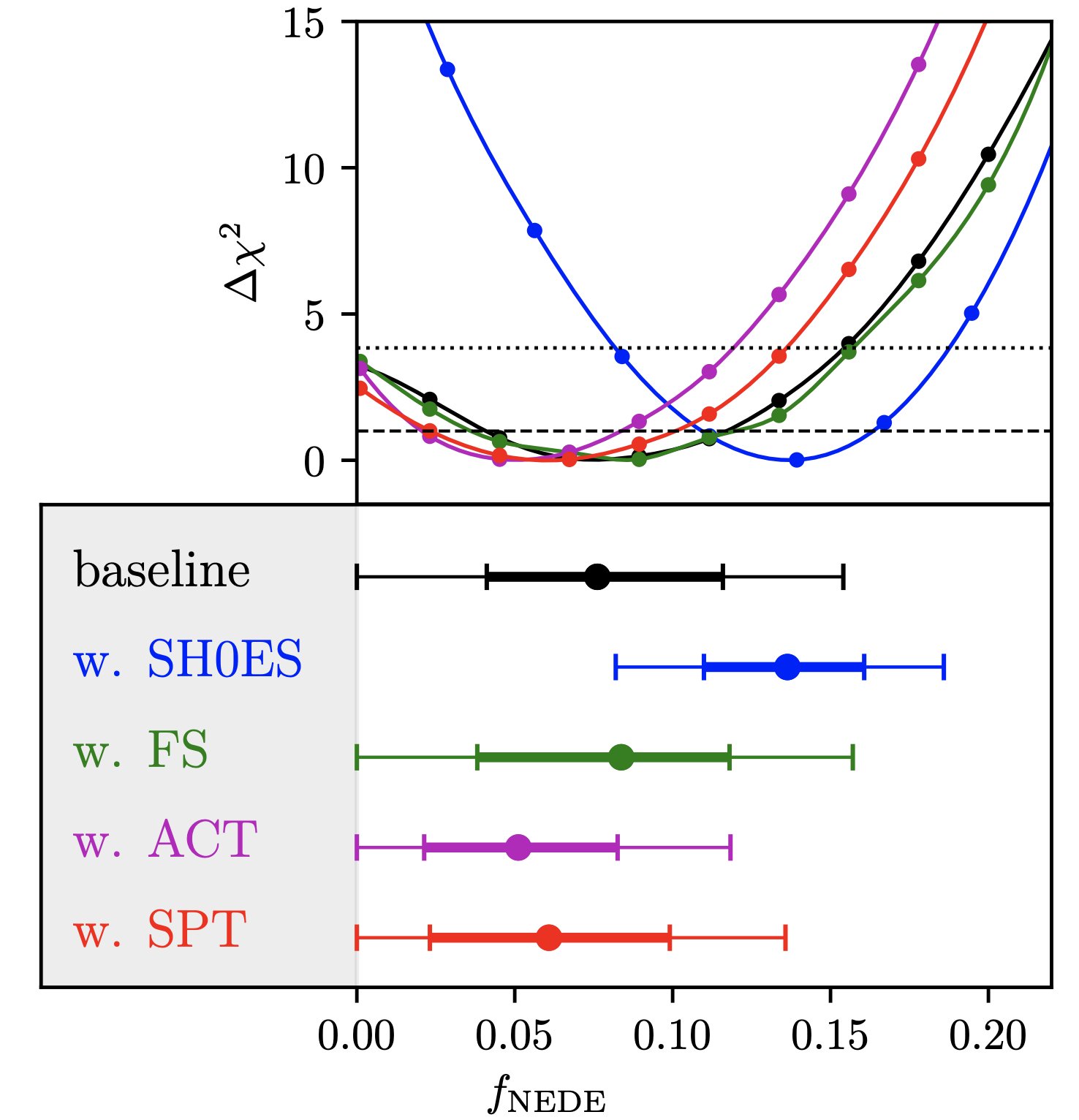
A new paper analyzing New Early Dark Energy (NEDE) using profile likelihood methods in collaboration with Aarhus U. group: Emil Brinch Holm, Thomas Tram, and Steen Hannestad and with Florian Niedermann at Nordita and Juan Cruz at SDU: https://arxiv.org/abs/2302.07934
In science, you have to be able to reach the same result by using different methods, and with the Hubble tension, physicists have a problem … here is a popular article about our method to solve this problem:
https://www.sdu.dk/en/nyheder/forskningsnyheder/boblende-univers
” NEDE model provides a larger posterior parameter space in comparison to the EDE model, being more suitable in alleviating the H0 and S8 tensions.” Interesting conclusions of today’s paper from Trieste:
My web seminar about New Early Dark Energy at CPPC in Sydney was recorded, so if you are interested in how it solves the Hubble tension, you can watch my take on it here: The Hubble tension and new physics at the eV scale
NEDE gives a best-fit value for the Hubble constant of H = 72 km/s/Mpc, but, as also originally found, with a more blue scalar spectrum implying that the simplest curvaton model is now favored over the Starobinsky inflation model. https://arxiv.org/abs/2209.02708 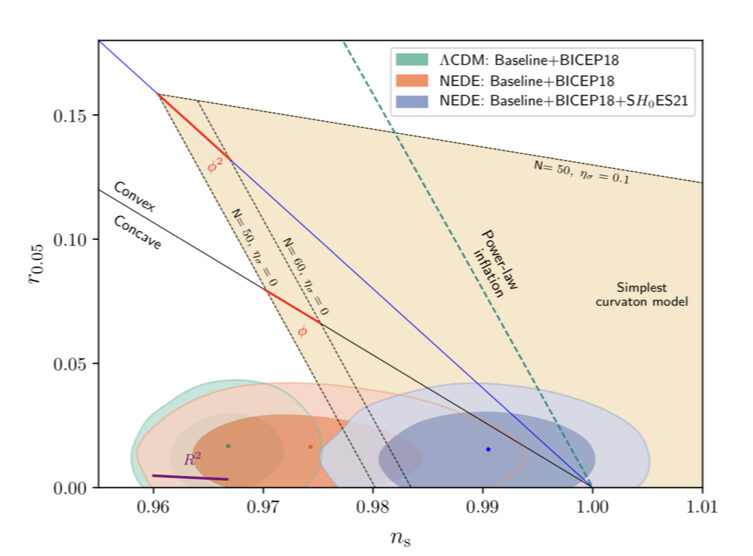
“How the universe works” episode about the Hubble tension. Our New Early Dark Energy theory is explained 21 min and 30 sec in:
Podcast om universet: Jeg svarer på spørgsmål om forskning i universet:
The James Webb Space Telescope will also help us to get to the bottom of the Hubble tension #JWST #HubbleTension
New SH0ES results find H_0 = 73 pm 1. A 5-sigma tension with Lambda-CDM. Exciting!