Researchers at CP3-Origins find that their New Early Dark Energy model, proposed as a solution to the Hubble tension, is compatible with current Large Scale Structure data: https://t.co/6PklcilCjI
— CP³-Origins (@CP3Origins) September 3, 2020
Gravitational atoms could form from Planckian Interacting Dark Matter (PIDM) in the early universe — we computed this and the gravitational wave signature of their decay: https://arxiv.org/abs/1903.12168
An exciting thing about NASA’s selection of the SPHEREx mission, it is that they claim to probe non-Gaussianity parameter |f_NL|<1 thus being sensitive to the simplest curvaton model f_NL = -5/4
https://www.nasa.gov/press-release/nasa-selects-new-mission-to-explore-origins-of-universe
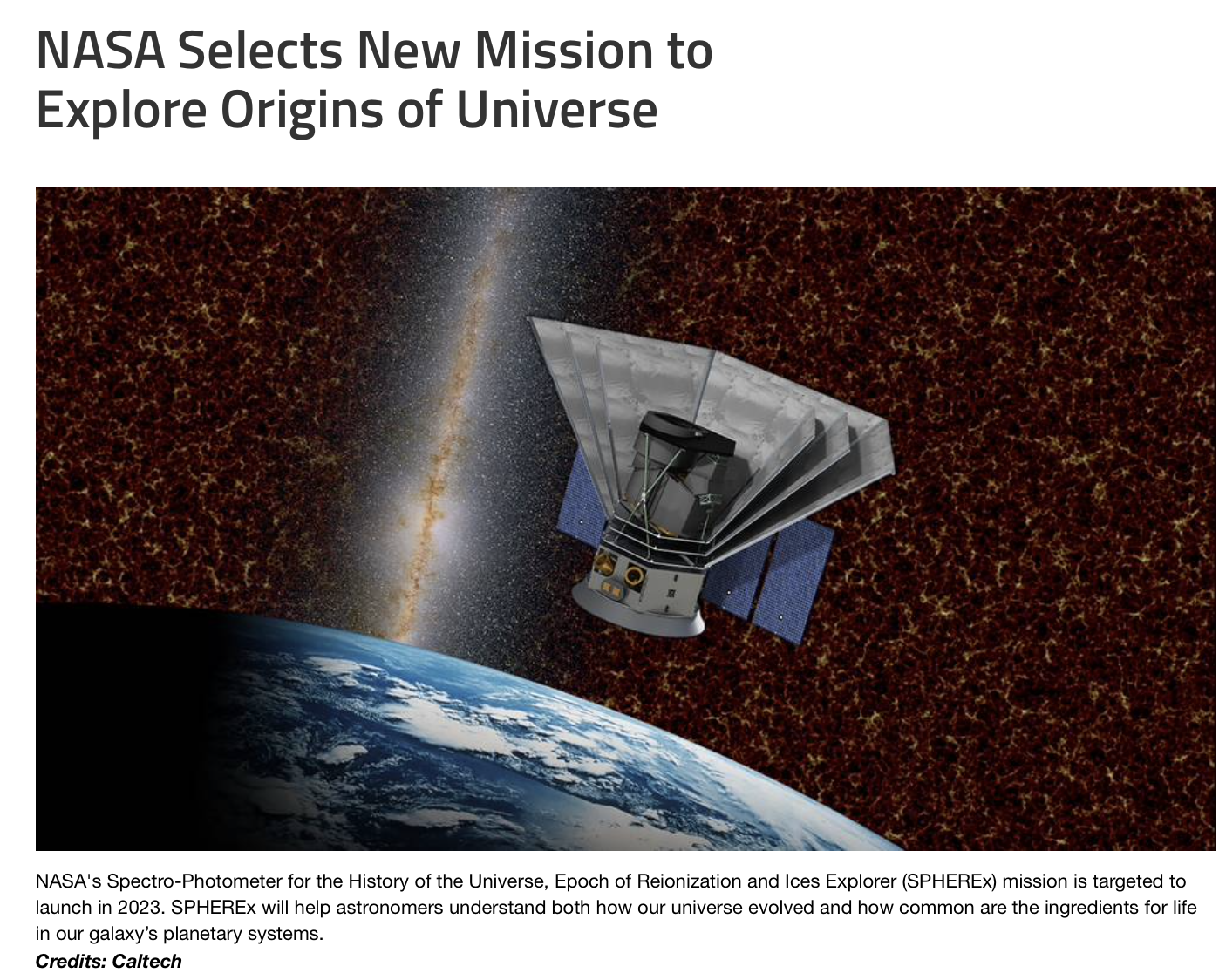
SPHEREx håber at teste curvaton-teorien for universets oprindelse:|f_NL |>1 mod simpleste inflationsteori |f_NL| <1 https://go.nasa.gov/2wvTbPF
Welcome!
Aside
Martin S. Sloth is a professor at the University of Southern Denmark (SDU) and the leader of the Universe Origins group. He is the first professor of theoretical cosmology in Denmark. Selected research highlights:
- His proposal of the curvaton mechanism.
- His work on non-Gaussianity and the discovery of the SSV consistency relations for exchange diagrams.
- His work on IR effects in inflation and the discovery of the GS consistency relations for IR loop effects in de Sitter and inflationary spacetimes.
- The FSS relations of soft theorems, soft charges, and asymptotic symmetries, and the Soft gravitons as Goldstone modes of spontaneously broken asymptotic symmetries in de Sitter spacetimes.
- His work on Inflationary magnetogenesis and the discovery of the consistency relations for cosmic magnetic fields.
- His universal constraints on axions from inflation.
- His paradigm of Planckian Interacting Dark Matter (PIDM).
- Most recently, he proposed a solution to the Hubble tension, New Early Dark Energy (NEDE), and predicted and found around 2.5σ evidence for a Dark Acoustic Oscillation (DAO) in the DESI data, as well as indications of features in the primordial power spectrum from inflation in the ACT data.
We mainly work on understanding the origin of the universe, dark matter, and dark energy. You can find more information about our research here. If you are interested in more popular descriptions of our research, you can look for some of our outreach activities here. On the group page, you can find a description of the group members. Finally, on the resource page, you can find lecture notes I made for various courses and publicly available codes that we developed in connection with our research.
E-mail: sloth@sdu.dk
Full list of publications of M. S. Sloth: HEP-INSPIRE, Google Scholar.
M. S. Sloth on Linkedin