Welcome!

Aside

Martin S. Sloth is a professor at the University of Southern Denmark (SDU) and the leader of the Universe Origins group. He is the first professor of theoretical cosmology in Denmark. Selected research highlights:

We mainly work on understanding the origin of the universe, dark matter, and dark energy. You can find more information about our research here. If you are interested in more popular descriptions of our research, you can look for some of our outreach activities here. Finally, on the group page, you can find a description of the group members.

E-mail: sloth@sdu.dk

Full list of publications of M. S. Sloth: HEP-INSPIRE, Google Scholar.

M. S. Sloth on Linkedin

New result for the Hubble tension from TDCOSMO using JWST. From three time-delay lenses, they find H0= 73.5 ± 2.8 km/s/Mpc, assuming the internal mass-sheet parameter λ_int = 1.

With new JWST imaging and spectroscopy, improved lens-environment estimates, and substantially revised modeling, the result is almost identical to the previous HST-based result for the same three lenses under the same λ_int = 1 assumption, H0 = 73.6 ± 2.6, while the scatter between the individual lenses is reduced. One caveat is the assumption λ_int =1, which will be treated as a free parameter in the forthcoming TDCOSMO-2026 analysis. However, existing TDCOSMO constraints put λ_int close to unity (or slightly above), with no empirical indication that freeing it should necessarily pull H0 toward the Planck value.

Another independent measurement, again landing on the high-H0 side.
arXiv:2608.27566

Interesting new paper by Shöneberg, Caldéron, and Lesgourgues showing that the DESI anomaly is resolved in early-time models addressing the Hubble tension, such as NEDE, without the need for additional late-time dynamical dark energy: https://arxiv.org/pdf/2608.07654 .

This is nicely consistent with our earlier findings, see for example figure 5 of “Dark Acoustic Oscillations as an Early-Universe Explanation of the DESI Anomaly” https://arxiv.org/abs/2512.15870 and figure 4 of ” The End of the First Act: Spectral Running, Interacting Dark Radiation, and the Hubble Tension in Light of ACT DR6 Data” https://arxiv.org/abs/2604.26541 .

Min kronik i Politiken i dag: “Robotterne er ved at ændre vores billede af universet”. Link til online versionen her (under paywall): https://politiken.dk/del/QIFYjSAHS1LQ

Kronikken handler om, hvordan robotter og kunstig intelligens ikke kun er ved at ændre samfundet, men også vores måde at se universet på. Nye teleskoper og enorme datamængder gør det muligt at måle kosmos med en præcision, der nu udfordrer den model, fysikere længe har brugt til at beskrive universet. Jeg skriver som professor i teoretisk kosmologi og som forsker midt i dette felt. Med kosmologien som eksempel er min pointe, at videnskabelige paradigmeskift ikke kun begynder med nye teorier, men også med de teknologier, der gør nye sprækker i verdensbilledet synlige.

“The H0 World Cup” is out (see links below). They have made a thorough update of “The H0 Olympics” paper from 5 years ago by the same core author group, with an extensive comparison of models in light of new data. This independent analysis shows that the Cold NEDE and Hot NEDE (with DRMD) models are among the leading models for solving the Hubble tension.

While Cold NEDE is clearly among the leading models (in the EDE class), Hot NEDE with DRMD (in the class of dark radiation models) is only among the leading models when allowing for running and running of the running of the spectral index, as also shown in our recent paper (“The End of the First Act”). In the short summary paper, this discussion is not included, and for the full picture of the DRMD model, one should read their second long paper (see links below).

The first short “The H0 World Cup” summary paper: https://arxiv.org/abs/2607.13282

The second long “The H0 World Cup” complete paper: https://arxiv.org/abs/2607.13283

For a YouTube video seminar where I discuss the Cold NEDE and Hot NEDE with DRMD models, and their similarities and differences, see f.ex.: https://www.youtube.com/live/VaaCsy4aPV0?si=bYtvFCzJS2AsXg5w

We might have observed “the end of the first act” of the universe’s evolution in recent high-precision CMB observations. In a new paper, we show that ACT DR6 data provide evidence for an accelerated running of the primordial spectral index, which would imply a breakdown of the first stage of inflation and, at the same time, resolve the Hubble tension in the DRMD Hot NEDE model (see previous posts). 

Inflation occurs during the first period of the universe’s evolution after the Big Bang, and observing the breakdown in the first stage of inflation therefore amounts to observing the end of the first act of the universe’s evolution. The accelerated running compensates for the increased damping at small scales in the CMB and therefore allows for a larger N_eff in models with self-interacting dark radiation, such as Hot NEDE with DRMD. The idea that inflation occurred in several acts (or stages) has long been considered more natural than 60 e-folds of single-field slow-roll inflation. In our paper, we also discuss how the end of the first act could occur through gauge-field production in axion monodromy-like inflation or through a tachyonic instability. For more details, see our new paper: https://arxiv.org/abs/2604.26541

Work in collaboration with Mathias Garny (Technical University of Munich) and Florian Niedermann (Nordita).

The Hubble tension and the DESI anomaly are considered to both seriously challenge the standard model of cosmology (the ΛCDM model).

In a new paper, we predict Dark Acoustic Oscillations (DAO) as the fingerprint of new dark forces required to resolve the Hubble tension in the Dark Radiation-Matter Decoupling (DRMD) model, naturally realised within the Hot New Early Dark Energy (Hot NEDE) setup. DAOs, with the same properties required to solve the Hubble tension, can independently explain the DESI anomaly.

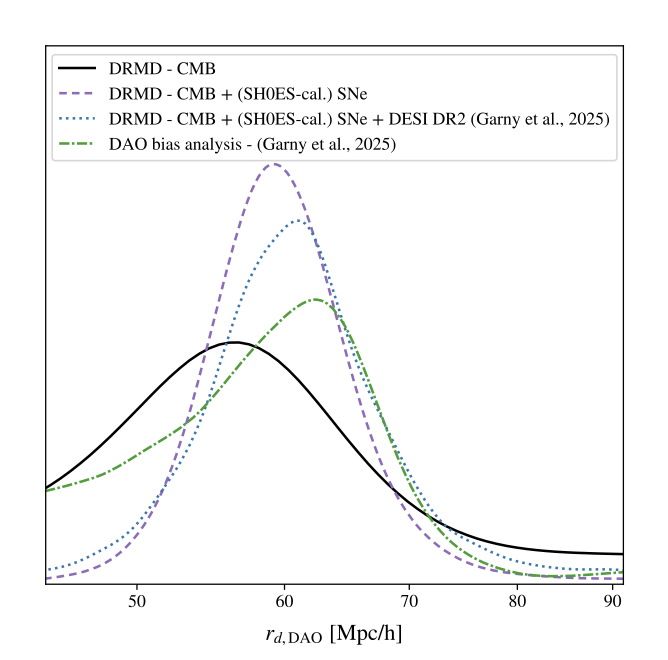
Using an inference independent of large-scale structure data, relying only on Planck measurements of the cosmic microwave background and SH0ES-calibrated supernova data, we find evidence for a DAO signal with drag-horizon scale rd,DAO ∈[54,65] Mpc/h (68% C.I.) and amplitude ADAO ∈[0.02,0.05] (68% C.I.). These predictions provide a concrete target for current and upcoming large-scale structure surveys, including DESI, Euclid, and the Roman Space Telescope.

It is remarkable that the scale and amplitude of the DAO required for solving the Hubble tension using only CMB and supernova data (no DESI BAO data), overlaps with the DAO scale and an amplitude independently preferred by the DESI BAO data (see my two previous posts), when the DESI anomaly is interpreted as being due to a DAO bias (as an alternative to the evolving dark energy interpretation) — providing a preliminary independent verification of DRMD’s relevance for solving the Hubble tension.

The work in collaboration with Mathis Garny and Florian Niedermann is on arXiv: https://arxiv.org/abs/2602.23895

Below is a cartoon illustration of the negative branch versus the positive branch discussed in the video linked in the previous post and in our paper: https://arxiv.org/abs/2512.15870

As we discuss in the paper:

On the positive branch, the DAO is almost on top of the BAO but at a slightly larger scale, and it will shift the perceived peak of the BAO slightly to the positive side of the DAO.

On the negative branch, the BAO and the DAO peaks are well separated, but close; the characteristic tail of the DAO can shift the perceived position of the BAO in the opposite
direction away from the DAO. In this case, the main peak of the DAO is assumed to be at a sufficiently small scale where it could be hidden by non-linear systematics in currently publicly available DESI DR2 data.

Both the positive and negative branches could potentially be discoverable in future DESI data releases or upcoming surveys like Euclid, by either resolving the DAO peak that overlaps closely with the BAO, or identifying a shallow DAO peak on scales∼50Mpc/h somewhat smaller than the BAO, consistent with our predictions in our earlier work as a result of solving the Hubble tension: https://arxiv.org/abs/2508.03795

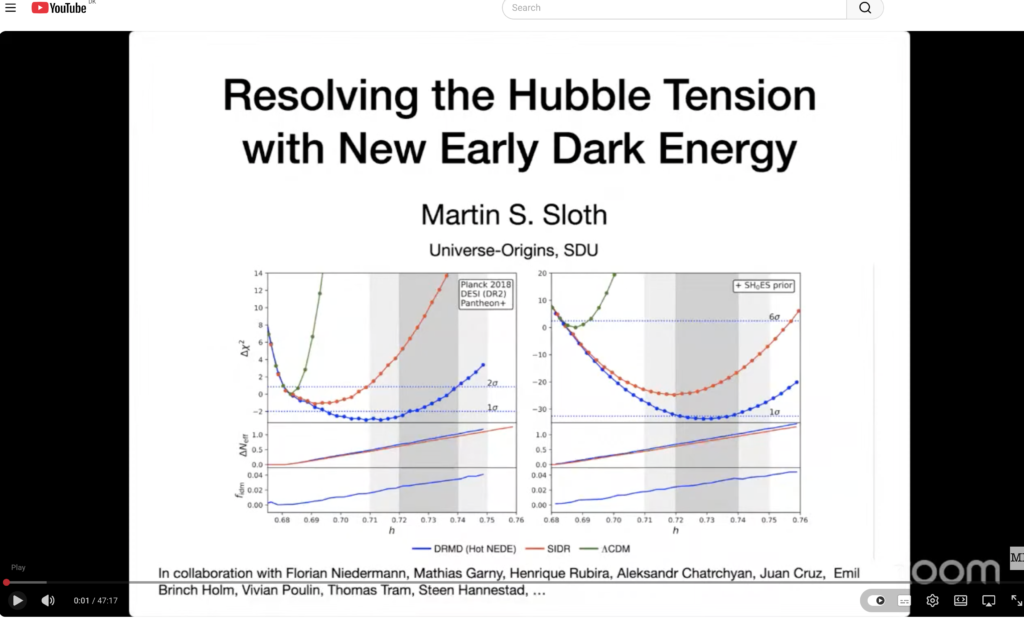
At a recent DESY (Hamburg) colloquium, I gave a review talk on “Resolving the Hubble Tension with New Early Dark Energy.”

I explained how the DESI anomaly might be connected to the Hubble tension and have an early-universe explanation in terms of dark acoustic oscillations. 

Link to: Slides + full video

The paper mentioned in the video clip below (now online): arXiv:2512.15870 — https://arxiv.org/abs/2512.15870

This builds on earlier work on New Early Dark Energy, with excellent collaborators: Florian Niedermann, Mathias Garny, Henrique Rubira, Aleksandr Chatrchyan, Juan Cruz, Emil Brinch Holm, Vivian Poulin, Thomas Tram, Steen Hannestad …